
Gary Epoxy Flooring installs ESD flooring in Gary, IN, serving surrounding cities including Lake Station, Griffith, Highland, Hobart and East Chicago. An ESD floor, short for electrostatic discharge, is a resinous floor built to carry static charge from people and equipment safely to ground, protecting sensitive electronics and reducing the risk of static sparks in controlled areas.
We have spent 20+ years preparing and coating concrete, and ESD systems are where preparation and detail matter most. The floor only works if every layer does its job: a sound, ground slab, a conductive primer, copper grounding strips tied to building ground, and a topcoat formulated to stay in the specified resistance range for years.
Our ESD proposals name the target resistance range and the test method, along with the usual items we put in every proposal: the surface preparation method, the moisture test and passing reading, the product line, the number of coats and the finished thickness.
Where ESD Floors Are Used
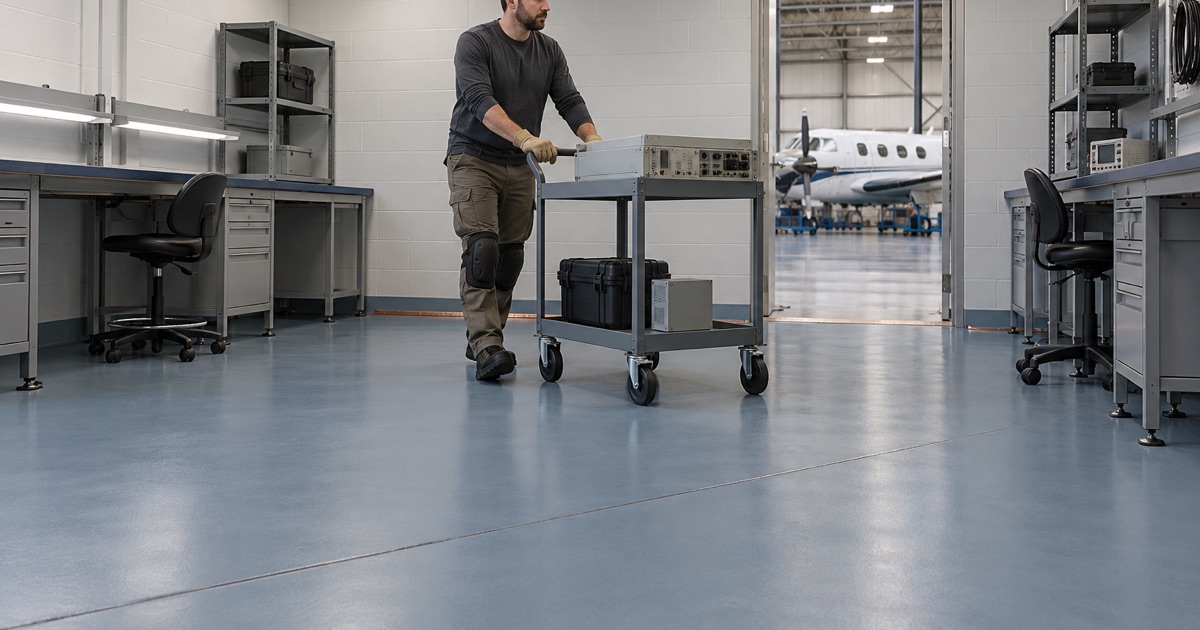
Electronics Assembly and Repair
Electronics assembly, repair and testing areas use ESD floors to keep static from damaging circuit boards and components. A charge too small for a person to feel can still damage a sensitive part, and the floor is one of the main ways a facility controls that charge.
These facilities often follow ANSI/ESD S20.20, which looks at the person, footwear and floor together. The floor is designed to work with the facility’s ESD footwear or heel grounders, not as a standalone fix.
Data Centers, Server and Control Rooms
Data centers, server rooms and control rooms protect expensive equipment and need floors that limit static buildup as people move through them. An ESD epoxy floor gives a seamless, easy-to-clean surface that fits these spaces where raised flooring is not used.
Control rooms in plants and utilities around Northwest Indiana often sit inside larger industrial buildings. We phase ESD work around operations and keep dust contained so nearby equipment stays clean.
Labs, Clean Areas and Sensitive Storage
Laboratories, medical device areas and rooms that store sensitive components benefit from the same static control. The seamless surface also resists chemicals and cleans easily, which suits lab and clean-area use.
Some facilities need static control for safety rather than product protection, such as rooms where flammable vapors or fine powders are handled. Those spaces usually have their own engineering requirements, and we work from the facility’s specification and safety staff rather than offering a generic floor for a hazard-specific need.
Conductive and Static-Dissipative Systems
Choosing the Resistance Range
ESD floors are classified by electrical resistance. Under ANSI/ESD STM7.1, conductive floors measure at or below 1.0 x 10^6 ohms, and static-dissipative floors measure above that and below 1.0 x 10^9 ohms. The right choice depends on your equipment, standards and quality program.
We work from your specification or your equipment maker’s requirements, and we confirm the range in writing before ordering material. Choosing the wrong range is an expensive mistake to fix after installation.
System Resistance and Body Voltage
ANSI/ESD S20.20 measures the system, a person wearing ESD footwear standing on the floor. It requires a system resistance below 1.0 x 10^9 ohms, or a body voltage test showing less than 100 volts peak as a person walks. The floor and footwear have to be matched for the system to pass.
We can test the installed floor and explain how your footwear program fits with it, so the floor and the footwear are not chosen in isolation. A floor that passes on its own can still fail the system test with the wrong footwear.
How an ESD Floor Is Built
Slab Preparation and Moisture Testing
We grind or shot blast the slab to the profile the system requires, repair cracks and spalls, and test for moisture with ASTM F1869 calcium chloride kits or ASTM F2170 relative humidity probes. Moisture problems cause the same blistering and peeling on ESD floors as on any coating, and they can also affect resistance readings.
Where readings run high, a moisture-mitigation primer goes down first, compatible with the conductive layers above it. We confirm that compatibility with the system manufacturer before ordering.
Cracks and joints are filled with materials that will not interrupt the conductive path, and old coatings are removed completely. An ESD system bonded over a failing older coating loses both adhesion and electrical continuity where the old film lets go, which shows up later as dead spots in resistance testing.
Grounding Strips and Conductive Primer
Copper grounding strips are laid on the prepared slab at set intervals and connected to building ground points. A conductive primer goes over the strips, creating a continuous path for charge to travel to ground.
The number and placement of ground points depend on the floor area and the manufacturer’s system requirements. We coordinate with your electrician for the final ground connections.
ESD Topcoat and Testing
The ESD topcoat contains conductive materials distributed evenly through the resin, so charge moves through the surface to the primer and grounding below. The topcoat also provides the wear, chemical resistance and clean look of a standard epoxy floor.
After cure, we test resistance at multiple points across the floor and record the results. Those readings are your baseline for future testing as part of an ESD control program.
Keeping an ESD Floor in Range
Cleaning Without Insulating
Waxes, floor finishes and cleaner residue can coat an ESD floor and push its resistance out of range. We recommend manufacturer-approved cleaners and simple maintenance routines that keep the surface clean without adding an insulating film.
Periodic Retesting
Many facilities retest ESD floors on a set schedule. Regular testing catches drift early, whether from residue, wear or damage, so a problem area can be cleaned or repaired before it affects production.
Rolling carts, chair casters and heavy equipment wear ESD topcoats in lanes just as they wear standard coatings. When readings drift in a worn lane, a recoat with the matching ESD topcoat restores the surface without replacing the full system, provided the conductive primer and grounding below remain intact.
Indiana VOC Limits
ESD systems are selected within Indiana’s 326 IAC 8-14 limits, which cap floor coatings at 250 g/L and industrial maintenance coatings at 340 g/L, and which apply to whoever applies the coating anywhere in the state.
- 20+ Years Coating Concrete
- Written Moisture Testing
- Free Estimates