Gary Epoxy Flooring installs metallic epoxy floor systems in Gary, IN, serving surrounding cities including Lake Station, Griffith, Highland, Hobart and East Chicago. Over 20+ years of coating concrete, we have learned that a metallic floor is the most demanding finish we install: the look is made by hand while the resin is wet, and the slab beneath it has to be flatter and cleaner than for almost any other system.
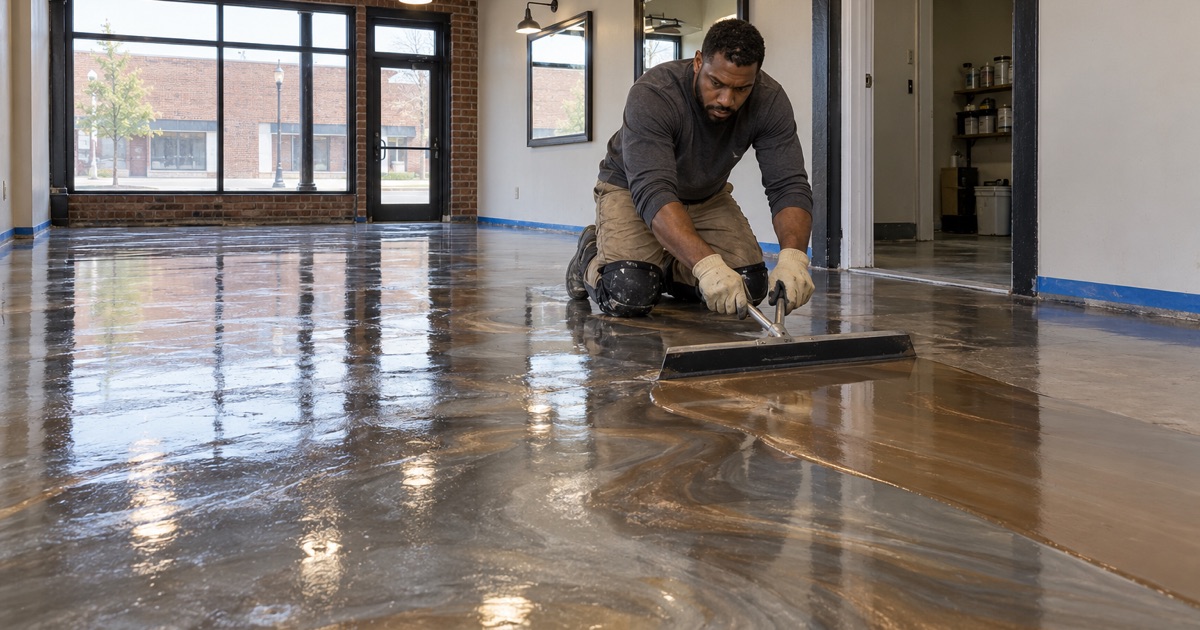
Metallic epoxy uses pearlescent pigments suspended in a clear resin. As the installer moves the material with rollers, trowels, brushes and sometimes solvent sprays, the pigments catch the light at different angles and create a marbled, flowing finish that looks like polished stone, liquid metal or swirling water, depending on the colors and technique chosen.
Because the finish is clear and reflective, it shows every flaw underneath it. A crack, a patch or a ridge left from poor grinding can telegraph straight through, so our metallic proposals name the surface prep method, the repair scope, the moisture test and the passing reading, the product line, the number of coats and the finished thickness before work begins.
Residential Metallic Epoxy Floors
Finished Basements and Lower Levels
Finished basements are where metallic floors are most often installed in homes, turning a plain concrete slab into a family room, bar area or home theater floor that looks like a designer surface. The coating is seamless, so there are no grout lines to clean and nothing for spills to soak into, which suits spaces where kids, pets and gatherings are part of everyday life.
Basement slabs need the same moisture testing here as for any other coating, and older slabs around Gary often have no vapor retarder below them. If readings are high, a moisture-mitigation primer goes down before the metallic coat, because vapor pushing up from below can blister a metallic finish and leave cloudy spots that cannot be polished out.
Showroom and Hobby Garages
Collectors and hobbyists sometimes want a garage that looks like a showroom, and a metallic floor delivers that. In a heated garage that sees little road salt, a metallic epoxy floor with a durable topcoat can look striking for years, especially under good lighting that brings out the depth of the pigments.
For an everyday garage that takes snowmelt and rock salt through the winter, we are honest that a flake floor is usually more practical. Metallic finishes show scratches, tire marks and salt residue more readily, and we would rather recommend the right floor than sell a look that fights the way the space is used.
Kitchens, Living Areas and Converted Spaces
In slab-on-grade homes, additions and converted commercial spaces, metallic epoxy can serve as the main living floor. It is easy to clean, warm with radiant heat beneath it, and available in color combinations that range from soft neutrals to bold blues, coppers and charcoals.
In kitchens and living areas we pay extra attention to traction and protection. A satin topcoat hides fine scratches better than high gloss, and a clear grit additive can go into the final coat near sinks and entries where water lands on the floor.
Commercial Metallic Epoxy Floors
Retail, Salon and Showroom Floors
Retail stores, salons, car showrooms and restaurants use metallic floors to make an impression the moment a customer walks in. The seamless surface is easy to clean between customers, and the finish can be matched to brand colors or kept neutral to let displays stand out.
Commercial metallic floors are phased so the business can keep running, with pours timed overnight or over weekends. Because a metallic coat should be poured in one continuous session per area to avoid visible seams, we plan the sections around walls, doorways and natural breaks in the floor.
Offices and Lobbies
Office lobbies, reception areas and conference rooms benefit from a metallic floor’s polished look without the cost and upkeep of stone. A durable urethane or polyaspartic topcoat protects the finish from chair casters, rolling carts and daily foot traffic.
We recommend walk-off mats at entries in Northwest Indiana, where grit and salt come in on shoes for months each winter. Those small particles cause most of the fine scratches on any glossy floor, and keeping them at the door extends the life of the topcoat.
Lighting changes how a metallic floor reads more than any other finish. The same floor looks deep and dramatic under directional track lights and flatter under diffuse panels, so we look at the room’s fixtures with you before choosing colors, and we pour sample boards when a client wants to see them under their own lights.
Restaurants and Bars
Front-of-house restaurant and bar floors take spills, chair traffic and constant cleaning. A metallic floor with a chemical-resistant topcoat and added texture can handle that while giving the dining room a distinctive look.
Back-of-house kitchen floors are a different job. Hot water, grease and daily sanitizing call for urethane cement with a coved base rather than a decorative metallic system, and we design the two areas separately with a clean transition between them.
How We Install a Metallic Epoxy Floor
Grinding and Flattening the Slab
We grind the slab with diamond tooling to open the surface and remove old coatings, sealers and contamination. For metallic floors we grind more thoroughly than usual to remove ridges and trowel marks, because any high or low spot shows as a change in the pattern once the reflective coat is down.
Cracks, spalls and control joints are filled and ground flush, and the floor is vacuumed spotless. Any dust left on the surface becomes a visible speck in the finished floor, so cleanup before the pour is as important as the grinding itself.
Primer and Base Coat
A primer or moisture-mitigation primer goes down first, followed by a tinted epoxy base coat that sets the background color. The base color affects how the metallic coat reads, so a dark base deepens the pigments while a light base brightens them.
The base coat also gives a final chance to correct small imperfections, since it levels shallow pits and fills pinholes. We let it cure and lightly sand it if needed so the metallic layer bonds to a clean, uniform surface.
The Metallic Coat
The metallic layer is mixed in batches and spread across the floor, then worked by hand to create the movement and veining you chose. Timing matters here, because the pattern has to be formed while the resin is open and before it starts to gel.
We work in teams on larger floors so wet edges never dry before the next batch meets them. That is how a large basement or showroom floor ends up looking like one continuous surface rather than a patchwork of separately poured sections.
UV-Stable Topcoat
A clear polyaspartic or urethane topcoat seals the metallic layer, protects it from scratches and holds its color under sunlight. We choose a sheen from satin to high gloss and add grit where traction matters.
Every product is selected inside Indiana’s VOC limits under 326 IAC 8-14, which cap floor coatings at 250 g/L and bind whoever applies them. We leave written cure times for foot traffic, furniture and vehicles, so the finish is not marked before it hardens.
Before the job is sold, we also walk through what the written warranty covers and what it leaves out. Moisture rising through the slab is the first exclusion on nearly every coating warranty, followed by impact damage and chemicals left standing, and on a clear decorative floor those limits are worth understanding before the first pour.
- 20+ Years Coating Concrete
- Written Moisture Testing
- Free Estimates